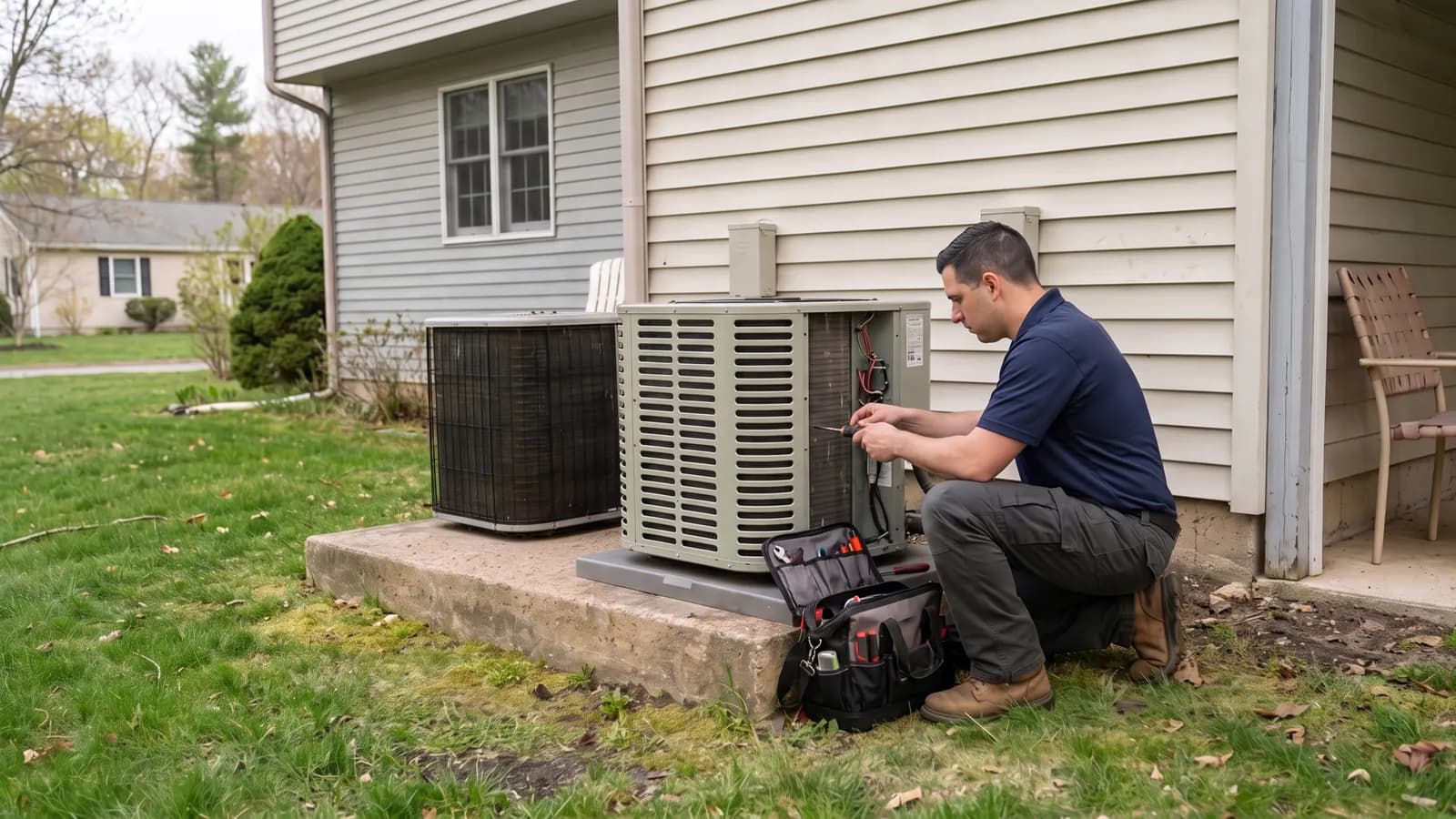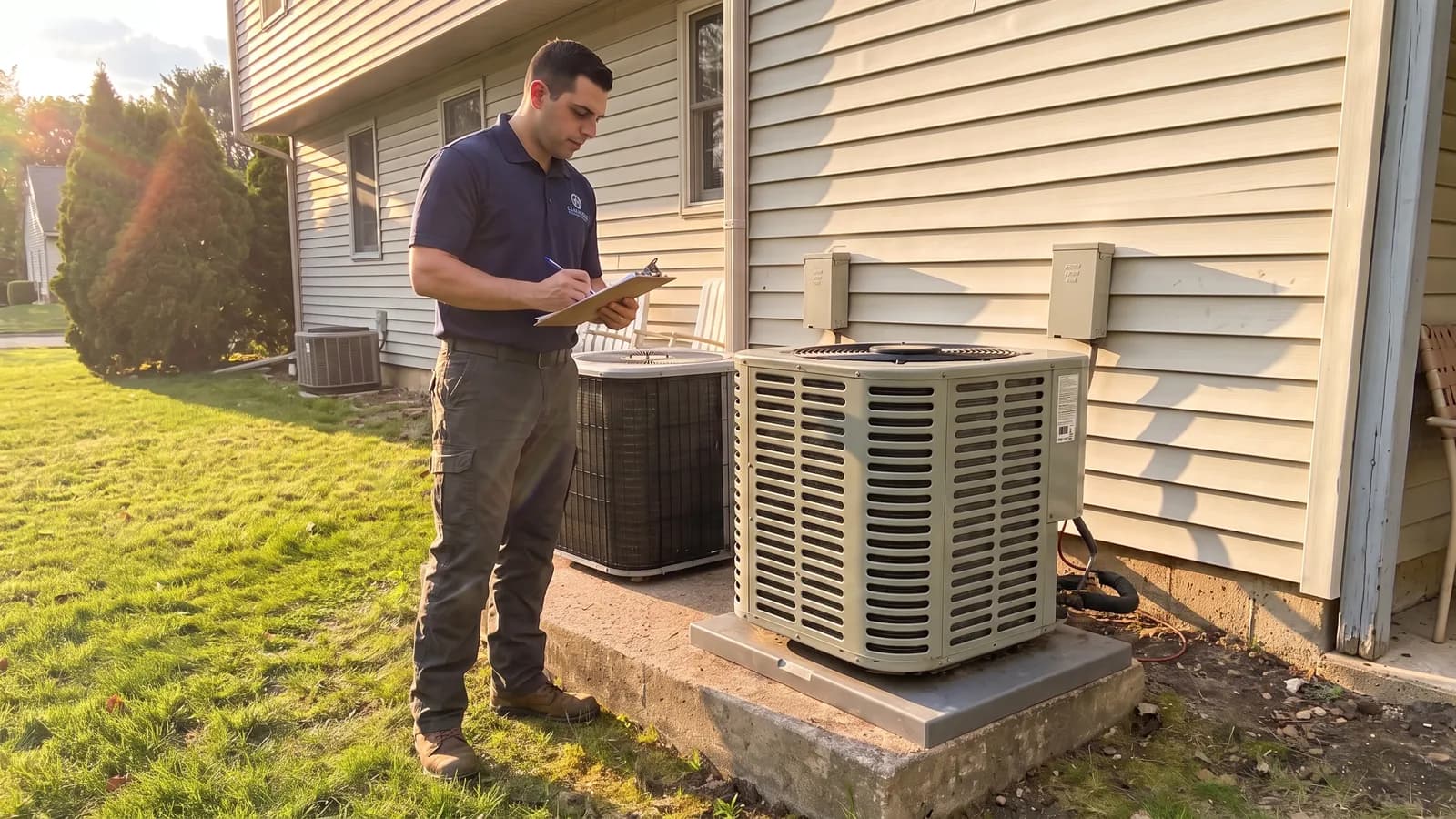
This is the call we get most from June through August, from Plymouth to Needham: "it's running — I can hear it — but it's blowing warm." The good news is that the causes are predictable, and they sort neatly from free-to-check to genuinely-bad-news. Work the list in order.
First: the three things to check yourself
- 1The air filter. A packed filter strangles airflow until the evaporator coil can't absorb heat — the air moves, but nothing's cooling it. If the filter looks like felt, swap it, then give the system a couple of hours.
- 2Power to the outdoor unit. Central AC has two power feeds: the indoor air handler and the outdoor condenser. If the condenser's breaker tripped or someone pulled the outdoor disconnect (kids and landscapers both love that gray box), the inside fan keeps blowing — warm. Check the panel and the disconnect by the condenser.
- 3The thermostat. Confirm it's on COOL, not just FAN. Set it 5°F below room temperature. If the screen is blank or flaky, replace the batteries. A dying thermostat is a convincing impostor of a dead AC.
4. A frozen evaporator coil
Ice on an air conditioner is always a symptom, never the disease. Either airflow is too low (dirty filter, crushed return duct, dead blower) or refrigerant is low from a leak. The coil gets colder than design, condensation freezes on it, ice blocks more airflow, and the spiral continues until warm air is all you get. Thawing it restores cooling for a while — but if we don't find *why* it froze, it'll freeze again on the next humid week. This is exactly the kind of failure a spring tune-up is designed to head off.
5. A failed capacitor or contactor
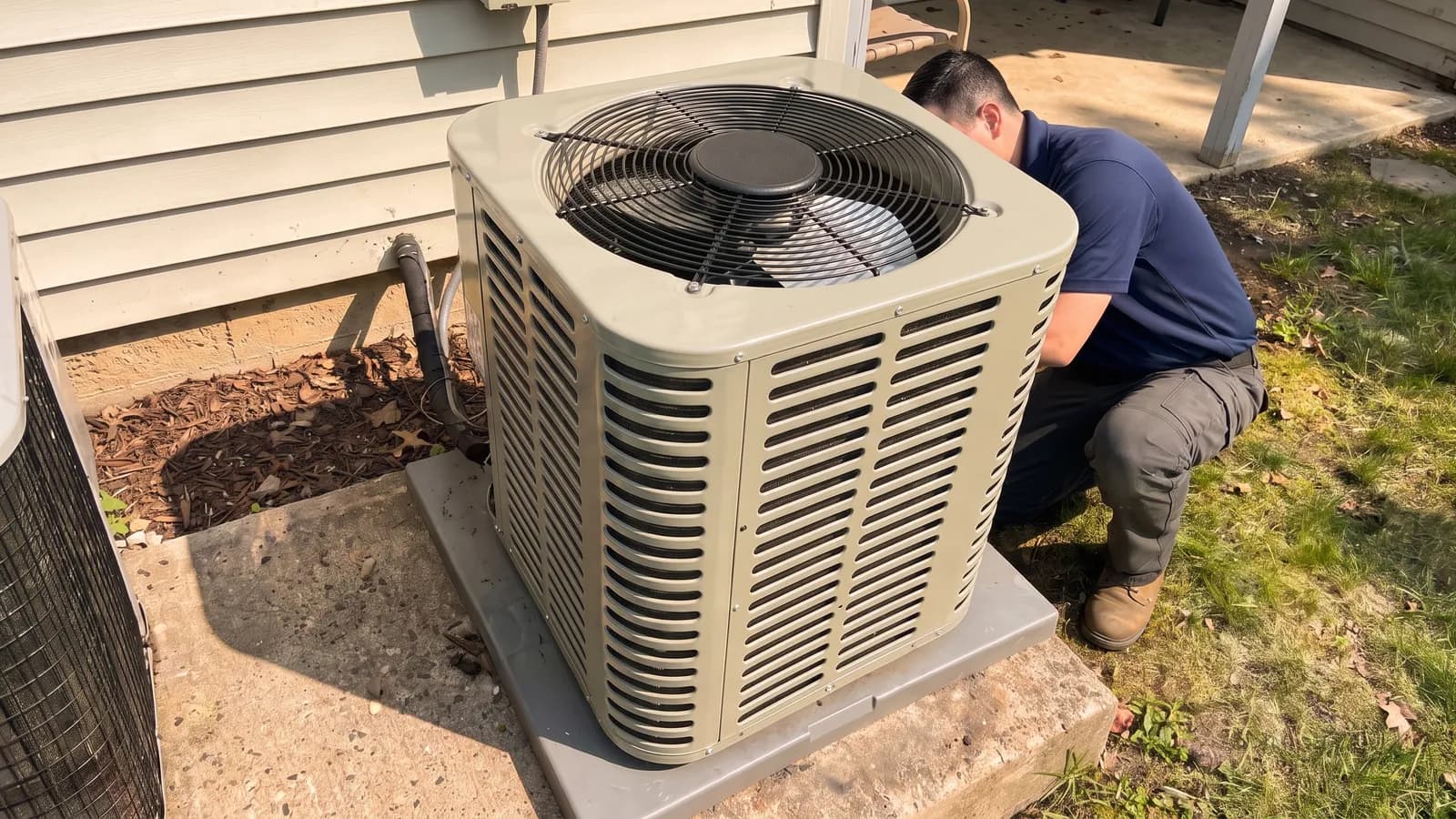
Walk out to the condenser. If the fan on top isn't spinning — or the unit hums and clicks but won't start — the run capacitor is the prime suspect. It's the part heat kills most often: capacitors weaken with every scorching afternoon, then quit entirely during the heat wave. The repair is quick and inexpensive, and we carry capacitors and contactors on the truck, so this is usually a same-visit fix on an AC repair call. Try the pencil-trick videos at your own risk: capacitors hold a charge even with power cut, and we'd rather you spend the $50 repair coupon than a trip to urgent care.
6. Low refrigerant — which means a leak
Here's the thing the topping-off guys won't say: refrigerant doesn't wear out, evaporate, or get consumed. It circulates in a sealed loop forever. If your charge is low, the loop has a hole. Symptoms: the AC cools poorly on hot days but okay at night, runs constantly, ices up, or the big line outside isn't cold and sweating like it should be.
A "charge it and see you next summer" visit turns into an annual subscription — at 2026 refrigerant prices, an expensive one. The honest path is a leak search (electronic detection, dye, or nitrogen pressure testing), then a decision: repair the leak and recharge, or — if the unit is old and running phased-out refrigerant — put that money toward replacement instead. We'll show you the math on both.
7. The compressor itself
The one nobody wants. If the outdoor fan spins but the compressor won't start (breaker trips, loud hum, or dead silence from the big cylinder inside), and it isn't the capacitor, you're into hard-start kits at best and compressor replacement at worst. On a newer unit under warranty, replacement can make sense. On a 12–15-year-old system, that money is almost always better spent on a properly sized new installation — especially with current rebates and the $500 install coupon in play. We tell you which side of the line you're on before any work starts.
The 15-minute rule
Our advice to every caller: spend fifteen minutes on the filter, the breakers, and the thermostat. If none of those bring cold air back within a couple of hours — or you see ice, hear grinding, or smell anything burnt — stop there. A diagnostic visit pins the actual fault in 15–20 minutes, the fee applies toward the repair, and we answer (508) 944-7623 24/7 across Southeastern Massachusetts, from Lakeville and Wareham up through the South Shore.